
How Florida Can Turn AI Data Centers Into More Power, Lower Energy Costs, and Stronger Communities

What if every major new AI data center helped finance more electricity generation, battery storage, and energy resilience for the communities around it?
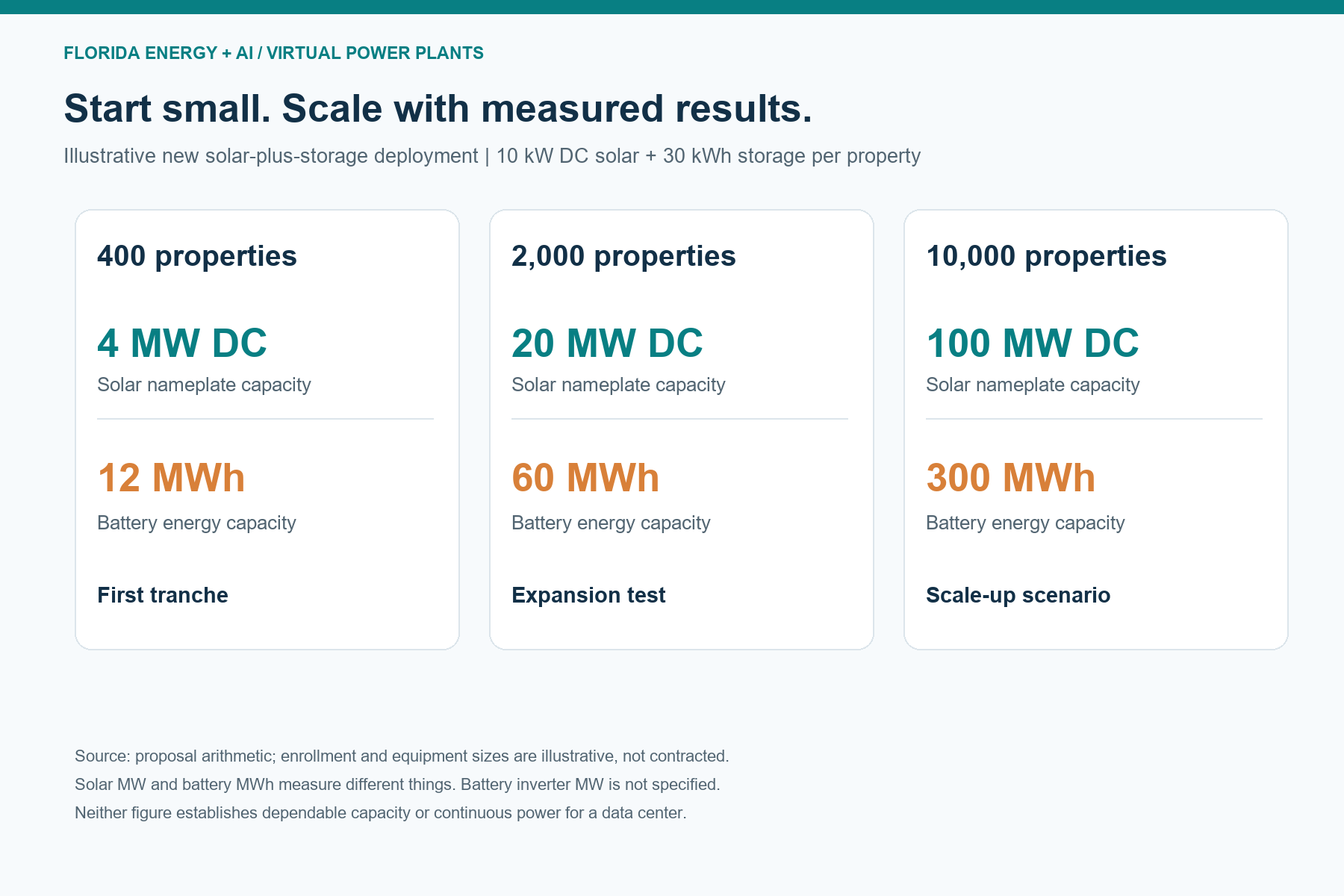
Imagine 10,000 Florida homes equipped with 10 kW of solar and 30 kWh of battery storage. Together, that’s 100 MW of solar generation capacity and 300 MWh of installed battery storage. Families gain a potential source of backup power during hurricanes. Utilities gain access to coordinated energy resources. And data-center developers help finance infrastructure that benefits the communities hosting their facilities.
This isn’t a promise that 300 MWh is available to the grid. Actual delivery would be smaller and independently verified. But it illustrates the opportunity.
An illustrative scale-up vision, not committed enrollment: the 100 MW is solar DC nameplate capacity, not firm power.
AI computing needs electricity for servers and cooling. Meeting that demand can require new power plants, substations and wires. Without sound cost allocation, existing customers could carry costs they did not create.
My proposal: data centers pay their own service costs and help finance community solar and batteries. A virtual power plant, or VPP, uses software to coordinate smaller energy resources so they support the grid together. Households could receive affordable storage, protected backup power and potential bill savings. Utilities could gain verified capacity when and where needed; developers could gain a more flexible path to power and a stronger community partnership, subject to approval.
I’m Joseph Kenney, an electrical contractor and co-founder of PowerSol USA. Installing solar and batteries in Florida has taught me to start with the household: what needs to stay on, who pays, and what happens in a storm?
Data centers shouldn’t just consume power. They should help create the infrastructure that produces, stores, and manages it.
My policy brief, Community Energy Infrastructure for AI Data Centers, proposes a voluntary Florida pilot to test that idea.
Why Florida AI data centers raise a household-bill question
Data center electricity demand is growing nationally. Berkeley Lab’s 2024 report estimated 176 terawatt-hours (TWh) of U.S. data-center electricity use in 2023. Its 2025 Update, published in June 2026, models a 2030 reference case of 649 TWh, with compounded-uncertainty scenarios spanning 521–843 TWh.

Those figures justify planning for AI power demand, not assuming every announced project will arrive on schedule. For Florida energy infrastructure, the question is how to accommodate new loads while protecting electricity affordability and preparing for hurricanes.
Virtual power plants can contribute flexible grid capacity. They complement firm generation, transmission and distribution upgrades; they do not replace the need for additional dependable electricity supply.
How a community virtual power plant would work
The proposed responsibility chain is straightforward:
AI data-center investment → utility-approved community energy program → competitively installed solar and batteries → independently verified grid services → measurable homeowner and community benefits.
Solar, residential battery storage and controllable equipment are examples of distributed energy resources: smaller assets located across homes and businesses rather than at one central plant. A VPP coordinates eligible resources within utility-approved limits.
A sponsor would fund incremental resources; installers would compete on equipment and service; the utility would define where and when help is needed; an independent evaluator would verify delivery and household outcomes. Payments could reward equipment availability or measured grid service. That compensation is separate from any reduction in a household’s electricity bill.

Florida Utilities Should Lead the Next Layer
Florida utilities have already shown they can build solar at scale. SACE’s October 2025 Solar in the Southeast report lists 7,312 MW of utility-scale solar for FPL, 1,793 MW for Duke Energy Florida and 1,351 MW for Tampa Electric in 2024: 10,456 MW combined. It reports 2,890 MW of distributed solar across all Florida utilities. These are different scopes, not statewide utility-scale versus distributed totals, and neither measures dependable capacity.
Build on that capability. FPL, Duke and TECO could lead utility-coordinated community VPPs, multifamily solar and storage, and resilience hubs. Municipal utilities and electric cooperatives should be partners too. Utilities would identify useful locations, set interconnection and dispatch limits, and integrate verified performance into planning; competitive local contractors would install and maintain assets. Standard contracts, telemetry and public evaluation could make programs repeatable without bypassing each utility’s rules or tenant protections.
What Does the Community Get in Return?
Residents should be able to ask: What improves here, who qualifies, and how will we know?
I would judge the pilot by five proposed community benefits:
- Affordable battery storage and community solar access. Sponsor investment could reduce upfront barriers, subject to competitive prices and a funded program design.
- Emergency backup. Protected reserves and tested controls could support essential circuits during outages, within the limits of stored energy and equipment. See our guide to home battery backup in Florida.
- Potential bill savings and participation payments. Measure the program payment plus the remaining utility bill against benefits. Do not present gross solar production or a VPP payment as net savings.
- Local infrastructure investment. Evaluate multifamily storage and community resilience hubs that could support cooling, communications or other agreed critical services. Each hub needs an engineered load plan and a practical access plan.
- Opportunities for local electrical contractors and skilled workers. Open installation and maintenance procurement could create work for qualified local firms. Track local contract awards and workforce outcomes.
Energy independence here means more control over essential loads, not unlimited off-grid power or exemption from utility charges.
Include renters, apartment residents and lower-income households
A program that only serves single-family homeowners misses much of the opportunity. Multifamily and small-business tracks should document benefits reaching tenants, not just property owners. Lower-income households should have a meaningful route to participate without hidden fees or unsuitable financing.
Require landlord consent where needed, clear benefit allocation, no undisclosed rent pass-through, and fair treatment when residents move. Do not promise tenant bill credits before confirming the applicable metering, housing-program and utility rules.
Participation must be voluntary. Before enrollment, disclose ownership, total costs, maintenance, dispatch rights, data use, warranties and exit terms.
This Isn’t Just a Theory
The precedents are useful precisely because they are not all the same kind of evidence.
Google–Voltus: announced capacity target
On October 22, 2026, Google announced an agreement with Voltus to build a 1-gigawatt VPP in PJM, expanding an earlier 100-megawatt agreement. Google describes aggregating flexible resources at homes and businesses, including batteries, smart thermostats and industrial assets, with financial benefits for participants.
This announced target is not independently verified delivery. It demonstrates the commercial idea: a major electricity customer can help fund distributed capacity.
South Australia: operating residential VPP
South Australia’s government describes an operating VPP involving thousands of social-housing homes, using household batteries and solar to support customers and the grid. Tesla developed the program; ownership transferred to AGL in 2025. AGL owns and operates it, while Tesla remains involved in installation and maintenance on AGL’s behalf.
This is government-reported operating evidence, not a data-center-funded Florida program. Its customer offer and electricity-market rules cannot simply be copied here.
Duke University and RMI: research and design frameworks
Duke University’s Community-Integrated Virtual Power Plants separates community benefit from grid value: each must be demonstrated. A nearby battery does not automatically relieve the electrical constraint serving a data center. Duke University is not Duke Energy Florida.
RMI’s How Virtual Power Plants Can Help the United States Win the AI Race examines three illustrative commercial structures: pass-through funding for utility-managed VPPs, capacity transfer, and reliability reinforcement. Its Lightening the Load analysis explains how community solar, batteries, flexible demand and resilience hubs could complement campus and utility-scale measures.
These research and design frameworks help turn an idea into a testable program. A PJM capacity arrangement cannot be imported unchanged; Florida partners must establish the applicable contracts and rules.
Why a Data Center Would Invest
A properly located, independently verified VPP might reduce coincident peaks or defer some infrastructure investment if utility studies demonstrate relief of the actual constraint. Where regulators and the utility approve, it could support conditional grid-access arrangements with enforceable load limits, curtailment obligations and performance remedies—not an automatic right to connect sooner.
For developers, contracted grid services and measurable community benefits could justify investment alongside their own power projects. Household bill outcomes, backup availability and local procurement should be reported separately from grid delivery. As the Duke University framework emphasizes, proximity alone does not establish grid value. This does not eliminate dedicated electrical capacity, 24/7 dependable generation or transmission upgrades, and cannot erase full-cost-of-service obligations.
The Investment Opportunity: Turning Homes Into Distributed Energy Infrastructure
Data centers, infrastructure funds or other investors could finance third-party-owned solar-and-battery portfolios through a utility-coordinated VPP. The investor owns the assets and is contractually responsible for maintenance; households receive contracted energy and backup benefits. Approved energy services and other contractual payments could support portfolio revenue, without double counting services or assuming a Florida wholesale-market entitlement.
Long-term contracts with creditworthy counterparties and independently verified cash flows could make this investable infrastructure. They do not guarantee returns. Metered delivery, settlement records and independent audits would test whether contracted revenues materialize. Before financing, establish:
- Ownership and lifecycle costs: competitively bid capital costs, site rights, insurance coverage and deductibles, hurricane/flood exposure, maintenance, replacements and end-of-life removal. Do not silently shift owner obligations to households.
- Contract duration and consumer protection: align household, sponsor and service terms; disclose total payments, backup reserves, dispatch/data rights, complaints, early exit, home sale, buyout and owner-default protections. The ten-year model below is not a required contract term.
- Investor risk: stress-test construction delays, equipment degradation, outages, counterparty default, regulation, tax eligibility and uncontracted revenue. Fund reserves and assign performance remedies before treating projected payments as bankable.
What the funding model actually says
Under one illustrative financing scenario, a $30,000 home solar-and-battery system would require approximately $21,000 in outside support after accounting for the present value of participant payments and modeled operating costs. That funding gap is precisely why data-center investment could matter.
The simple capital gap is $12,000: $30,000 minus 120 monthly payments of $150. Discounting those future receipts and adding modeled upkeep produces the larger $20,992 present-value gap, rounded to $21,000.

See the full funding-gap assumptions
The model uses $30,000 upfront capital; $150 paid at each month-end for 120 months; an 8% nominal annual discount rate divided by 12 for receipts; and $500 of year-end operating/replacement costs annually for ten years, discounted at 8% annually. Present-value receipts are about $12,363; present-value upkeep is about $3,355; outside support is about $20,992.
No tax credit, VPP revenue or residual value is assumed. The 8% is a modeling discount rate, not a loan APR. Financing fees, defaults and costs beyond year ten could increase the requirement; verified service revenue could reduce it.

For household financing context, see solar financing in Florida without the federal tax credit.
A commercial ownership pathway
The residential §25D credit ended for expenditures after December 31, 2025; paying early does not qualify an installation completed afterward. An eligible commercial or third-party owner may instead qualify for §48E. The base credit is 6%; 30% requires prevailing-wage and apprenticeship compliance or an applicable exception. The small-system exceptions cover qualifying generation facilities below 1 MW AC and storage below 1 MW of power capacity—not 1 MWh of energy. Tax advisers must confirm the facility boundaries and ownership structure.
Solar beginning construction after July 4, 2026 must be placed in service by December 31, 2027. Earlier-start projects require qualifying commencement and continuity documentation. Storage is excluded from that solar cutoff: the general phaseout retains 100% of the otherwise eligible credit for construction beginning through 2033, 75% in 2034 and 50% in 2035. These percentages are phaseout factors, not credit rates.
Prohibited-foreign-entity restrictions apply to owners, and material-assistance sourcing restrictions apply to facilities and storage beginning construction after December 31, 2025. IRS Notice 2026-15 provides interim cost-ratio and safe-harbor guidance; verify applicable guidance and supply-chain records before commitment.
A fully realized 30% credit on the modeled $30,000 system is $9,000, reducing the $20,992 support gap to about $11,992 before depreciation. Eligible property acquired and placed in service after January 19, 2025 may qualify for 100% bonus depreciation. Basis is reduced by half the credit: $30,000 − $4,500 = $25,500; at the brief’s assumed 21% federal corporate rate, the deduction’s tax value is $5,355, leaving about $6,637 of modeled support. These face-value sensitivities are not guaranteed financing proceeds or discounted tax receipts; realization timing, transfer discounts, fees, recapture and owner tax capacity matter.
See IRS residential-cutoff guidance, section 48E and the 2025 law, IRS credit guidance and the brief’s detailed tax conditions. IRS Form 3468 instructions, Publication 946, enacted OBBBA §§70512–70513 and §50(c)(3) support these conditions and calculations. Require owner-specific tax review before commitment.

The capital scale: 400, 2,000 and 10,000 homes
| Scale | Gross installed capital | Solar nameplate | Installed storage |
|---|---|---|---|
| 400 homes | $12 million | 4 MW DC | 12 MWh |
| 2,000 homes | $60 million | 20 MW DC | 60 MWh |
| 10,000 homes | $300 million | 100 MW DC | 300 MWh |
At $30,000, 10 kW DC and 30 kWh per property, these are gross installation costs, not the amount a sponsor would necessarily contribute. Tax benefits, household payments, financing costs and contracted grid-service revenue change the investment requirement. MW DC and MWh are equipment measures, not accredited grid capacity.
Five commitments to protect families and other ratepayers
- The customer creating the cost pays for it. Preserve the data center’s full service obligations. Community investment must supplement them, never become a blanket discount against them.
- Buy verified results through open bidding. Compare lifecycle prices, warranties, interoperability and usable performance. Publish equipment and administration costs. PowerSol and other qualified firms should compete on equal terms.
- Protect the household first. Contracts must preserve an agreed backup reserve and suspend discretionary grid dispatch when household safety requires it, with storm rules and tested controls.
- Verify grid value and community benefit separately. Utility coordination and feeder-level planning must identify the electrically relevant location and hours. Publish household outcomes as well as delivered grid services; prevent double counting.
- Expand only after evidence. Review cost per dependable kilowatt, total household bills, reserve compliance, safety and effects on people who did not enroll.
Florida law is a foundation, not approval of this pilot
Florida Statutes section 366.043 requires public-utility tariffs designed to make qualifying large-load customers bear their full cost of service and prevent shifting those costs or nonpayment risk to other ratepayers. The definition generally starts at an anticipated monthly peak of 50 MW at one location, measured over a 15-minute interval, and includes qualifying colocation arrangements.
That enacted cost-allocation framework does not authorize this specific community VPP or guarantee that household rates cannot rise. Its October 1, 2026 tariff-filing deadline was not blanket approval of every utility proposal. The PSC’s November 3 vote sheet in Duke Energy Florida’s tariff proceeding records approval of a recommendation, as modified, to deny the tariff as filed with leave to refile.
A Florida pilot would need coordination with Duke Energy Florida, TECO, FPL, or the affected municipal or cooperative utility, plus applicable regulatory and interconnection approvals. Counsel must confirm the specific authority and compensation structure before anyone enrolls.
For household bill context, see our Duke Energy Florida solar and battery guide and FPL solar and battery guide.
What a battery can and can’t do

I’m a battery-first installer, so I’ll be straight about the limits. Batteries and solar are very useful, but they aren’t unlimited firm power, and a neighborhood full of batteries doesn’t automatically keep an AI campus running around the clock. Count what actually gets delivered, not the label on the equipment. In the brief’s example, 10,000 homes with 30 kWh batteries hold 300 MWh on paper, but after a 40% reserve, 10% losses and 90% availability only about 146 MWh is available to dispatch. Over four hours, that’s roughly 36 MW, before inverter and feeder limits. It’s an energy screen, not a utility-accredited capacity number.
For homes, that means a reserve sized to critical loads. As an example, a 30 kWh battery running a steady 2 kW of essential circuits is about 15 hours before losses. It is not whole-home air conditioning for days. Hurricane readiness should be a written service obligation, with pre-storm charging, wind-rated mounting, safe siting above flood levels and a post-storm repair plan.
That 15-hour example uses the full 30 kWh before losses and operating limits; it is not the backup duration of the 40% reserve above. That reserve would hold 12 kWh, or six idealized hours at the same steady 2 kW load before losses and operating limits. Your actual backup plan must be sized to your essential circuits.
The Speed Advantage: Build in Parallel, Not One Project at a Time
My PowerSol planning benchmark is 10 residential installations per week per three- or four-person crew—an illustrative production assumption, not an independently audited industry average or commissioning guarantee.
10 crews × 10 systems/week × 50 working weeks = 5,000 installed systems annually. At 10 kW DC solar and 30 kWh storage each, that is 50 MW DC solar and 150 MWh installed storage. Twenty crews at the same pace could install 10,000 systems in 50 working weeks: 100 MW DC and 300 MWh. Ten crews would need 100 working weeks for that larger case.
Continuous funding, ready sites, equipment and steady parallel work are assumed; weather, permitting, supply and utility readiness can interrupt production. Track distinct milestones: installed; inspected; interconnected with utility permission; commissioned with tested controls and telemetry; and utility-accredited for a defined grid service. Physical installation alone earns no capacity credit. Sequence and requirements vary by utility.
Larger infrastructure has different clocks:
- Georgia Power dates the Vogtle 3–4 expansion start to June 2009, with commercial operation in July 2023 and April 2024. One documented project is not a universal nuclear timetable.
- EIA’s 2026 modeling assumptions use two-year combustion-turbine and three-year combined-cycle lead times. Dedicated data-center power projects still face project-specific equipment, fuel, permitting and connection requirements; this is not an independent-grid delivery promise.
- Berkeley Lab’s Queued Up: 2026 Edition reports a median of over five years from interconnection request to operation for projects built in 2025 in regions with data. This transmission-connected sample is not a residential-interconnection forecast.
- DOE’s 2024 transmission assessment cites a review of over 30 projects averaging around ten years to develop, permit and build. DOE’s CITAP program targets two-year federal reviews for qualifying projects after pre-application—not two-year total delivery.
Build both intelligently: households could benefit in stages while larger projects proceed. A modular VPP does not replace firm generation or the wires serving an AI campus.
A 100-day design process, not a deployment promise

- Days 1–20: Bring utilities, regulators, residents, renters, emergency managers, lenders and contractors together.
- Days 21–45: The utility identifies where and when the grid is constrained. An independent evaluator sets how results will be measured.
- Days 46–70: Open bidding for equipment and services, plus financing terms and storm protocols.
- Days 71–100: Publish the engineering and cost case, hold a public go/no-go review, and start a small test group only if permits and the utility are ready.
I’d propose starting with about 400 properties, then moving to 1,000 to 2,000 only after independent review.
Water Is a Design Problem We Can Address
Water concerns deserve an engineering answer, not a dismissal. Berkeley Lab’s 2024 report estimated U.S. data centers directly consumed 66 billion liters in 2023, with a separate electricity-related water footprint of nearly 800 billion liters. Those are national estimates, not a water budget for a Florida site.
I wouldn’t say every data center uses less water than one golf course. GCSAA’s 2025 survey report puts median irrigation water applied per U.S. golf facility in 2024 at 68.9 acre-feet, about 22.5 million gallons a year. That’s a national median, not a Florida average. EESI reports examples of medium-sized data centers using up to roughly 110 million gallons annually for cooling and large sites up to 5 million gallons a day. Large evaporative-cooled campuses can exceed the golf benchmark by a wide margin.
The better question is: Which water source and cooling design does this particular site need?
- Reclaimed water where feasible. Florida DEP’s 2024 inventory reports about 958 million gallons per day reused for beneficial purposes statewide. That’s evidence of an existing reuse system, not spare water available to a new campus. Microsoft reports using reclaimed or recycled sources in several markets in its cooling-design announcement.
- Recirculating systems and low-water heat rejection. Microsoft’s announcement describes closed-loop, chip-level designs avoiding evaporation for cooling after initial fill, with new sites expected online beginning in late 2027. Restrooms and other uses remain. Cooling water could be below the golf irrigation benchmark without total water footprint being lower. A recirculating server loop does not eliminate evaporation if final heat rejection still uses a cooling tower.
- Dry and hybrid cooling. DOE describes cooling options and their constraints, including hybrid systems switching between air-cooled and evaporative heat rejection. Evaluate hot, humid Florida conditions, peak-day water needs and controls. Reducing cooling water can increase electricity demand and its upstream water footprint.
- Carefully evaluated alternative sources. Google’s operating Hamina site uses seawater cooling. Florida lake or seawater proposals need withdrawal/discharge permissions, intake protection and thermal/ecological safeguards. Nearby water is not free or unrestricted supply.
Publish water-use effectiveness (WUE)—annual site water use in liters per kWh of IT electricity—with the measurement boundary stated, alongside total annual consumption and peak-day withdrawals. A low ratio can still mean high total use at a large campus. Assess local watershed and seasonal impacts, actual potable-water displacement, competing reclaimed-water users, drought rules and discharge effects.
I would ask Florida’s large-load agreements to require suitable non-potable supply or low-water cooling where technically and environmentally feasible, with enforceable reporting. Developers should pay for the infrastructure they require.
We can pursue AI infrastructure and protect Florida’s water, but only by making the trade-offs visible and the commitments enforceable. Environmental concerns belong in the design process from the beginning.
Florida data-center and VPP FAQs
What is a virtual power plant?
A virtual power plant, or VPP, uses software to coordinate smaller resources such as batteries, solar and smart thermostats so they can support the grid together. It does not create a private power line from homes to a data center.
Can data centers help pay for home solar and batteries?
Yes, through a funded, approved arrangement. This proposal would use sponsor investment for competitively selected community solar and storage, in addition to the data center’s own electric-service obligations. No sponsor funding is committed yet.
Would participating households have backup power during hurricanes?
The pilot would protect an agreed reserve and suspend discretionary grid dispatch when household safety requires it. A properly configured battery can support selected loads, but runtime depends on stored energy, power limits, household use and equipment condition—not a promise of power throughout a hurricane.
Could a VPP reduce electricity costs?
Potentially. Compare equipment and program charges plus the remaining utility bill against savings and any payment for availability or verified grid service. This proposal sets no Florida payment rate or guaranteed net savings.
Does Florida already allow these programs?
Florida’s large-load law sets cost-allocation requirements; it does not approve this pilot. Specific program authority, utility and regulatory approvals, interconnection, financing and contracts must be established. A home battery purchase does not automatically enroll a customer in a VPP.
How would data-center developers benefit?
A properly located, verified VPP might reduce coincident peaks, defer some infrastructure or support conditional grid access where approved, alongside measurable community benefits. It does not eliminate dedicated capacity, 24/7 generation or transmission upgrades. Neither faster interconnection nor lower costs is guaranteed.
Would renters and apartment residents qualify?
The pilot should include multifamily and lower-income participation, with landlord consent where needed, documented tenant benefits and fair move-out terms. Eligibility and benefit arrangements would be set in the approved design; enrollment is not open.
Could a commercial VPP owner use business tax benefits?
Potentially. An eligible third-party owner may claim the business clean-electricity credit and depreciate qualifying equipment. In the illustrative $30,000 case, a fully realized 30% credit is $9,000, reducing the approximately $20,992 support gap to about $11,992 before depreciation. Ownership, timing, sourcing, labor, tax capacity and monetization must be reviewed; no homeowner residential credit for new 2026 spending is assumed.
Disclosure
I’m a co-founder of PowerSol USA and we could bid on a program like this. I’m not asking for an exclusive award, and the plan calls for independent bidding, independent verification and community representation. Nobody at Duke University, Duke Energy Florida or any other source cited in the brief has endorsed this proposal.
This is a proposed pilot, not an enrollment offer or an announcement of committed funding or utility approval. Financial and deployment examples are planning illustrations, not bids or guaranteed outcomes.
Let’s build the power—and the community benefits
This proposal is not anti-data-center, anti-nuclear or anti-utility. It combines private investment, utility capabilities, local contractors and household participation with other needed infrastructure. The aim is a viable investor opportunity, a useful data-center energy resource, measurable utility grid value, household resilience and potential savings, and responsibly managed environmental impacts—not a promise that every project will deliver all of them.
Policymakers, utilities and researchers: Explore a Florida pilot and independent feasibility study, with open procurement and public measurement.
Hyperscalers, data-center developers and investors: Discuss financing community energy infrastructure that delivers verified grid services and measurable local benefits.
Homeowners: Request a solar-and-battery estimate or call (855) 847-6527. PowerSol USA is headquartered at 600 N Willow Ave, Tampa, FL 33606. Confirm installation availability for your address.
Florida can become a national model for AI infrastructure that strengthens the grid and gives communities a measurable stake in the benefits. That takes private investment, utility leadership, policymakers, local contractors and household participation—not competing slogans about one technology replacing another. Let’s build the power AI needs and leave Florida communities better off because of it.